Skip to content
Red Carpet Plumbing logo

Slab Leak Detection and Repair in Green Valley, Henderson, NV

Slab leaks are among the most damaging plumbing problems in Green Valley, particularly in the original neighborhoods where aging copper and polybutylene pipes have been under hard water stress for 30 to 45 years. Red Carpet Plumbing locates slab leaks non-invasively using acoustic sensors, pressure testing, and thermal imaging, and presents all repair options before any work begins.

  • 4.8 stars, 76 Google reviews
  • NV Licensed, #0048585A
  • Over 40 years serving the Las Vegas Valley
  • 24/7 emergency service
  • Transparent pricing, no hidden fees

Licensed plumbers. Non-invasive detection. All repair options explained.

Get Slab Leak Help

Tell us what is going on and we will follow up promptly.

  • Non-Invasive Detection
  • NV Licensed, #0048585A
  • All Repair Options Explained
  • Residential and Commercial

Signs of a Slab Leak in Your Green Valley Home

The most common signs of a slab leak in a Green Valley home are warm or hot spots on floors, the sound of running water when all fixtures are off, and an unexplained increase in your water bill. Hidden slab leaks beneath concrete foundations can cause significant structural and water damage before any visible sign appears above the surface.

  • Warm or hot spots on your floors
  • The sound of running water when all fixtures are off
  • An unexplained increase in your water bill
  • Damp or wet flooring without an obvious source
  • Cracks appearing in walls, floors, or at the base of walls
  • Low water pressure throughout the home with no other explanation
  • Mold or mildew odor at floor level

If you notice one or more of these signs in your Green Valley home, call Red Carpet Plumbing at (702) 567-9172 or request service online. Slab leaks cause ongoing water loss and can damage your foundation if left undetected. For more on Green Valley plumbing conditions, see our Green Valley plumbing services page.

How Non-Invasive Slab Leak Detection Works in Green Valley

Locating a slab leak does not require breaking open large sections of concrete to search. Red Carpet Plumbing uses professional non-invasive detection methods to pinpoint the leak location before recommending a repair approach. For a broader overview, see our slab leak detection and repair services and our Green Valley leak detection and repair page.

Acoustic Electronic Detection

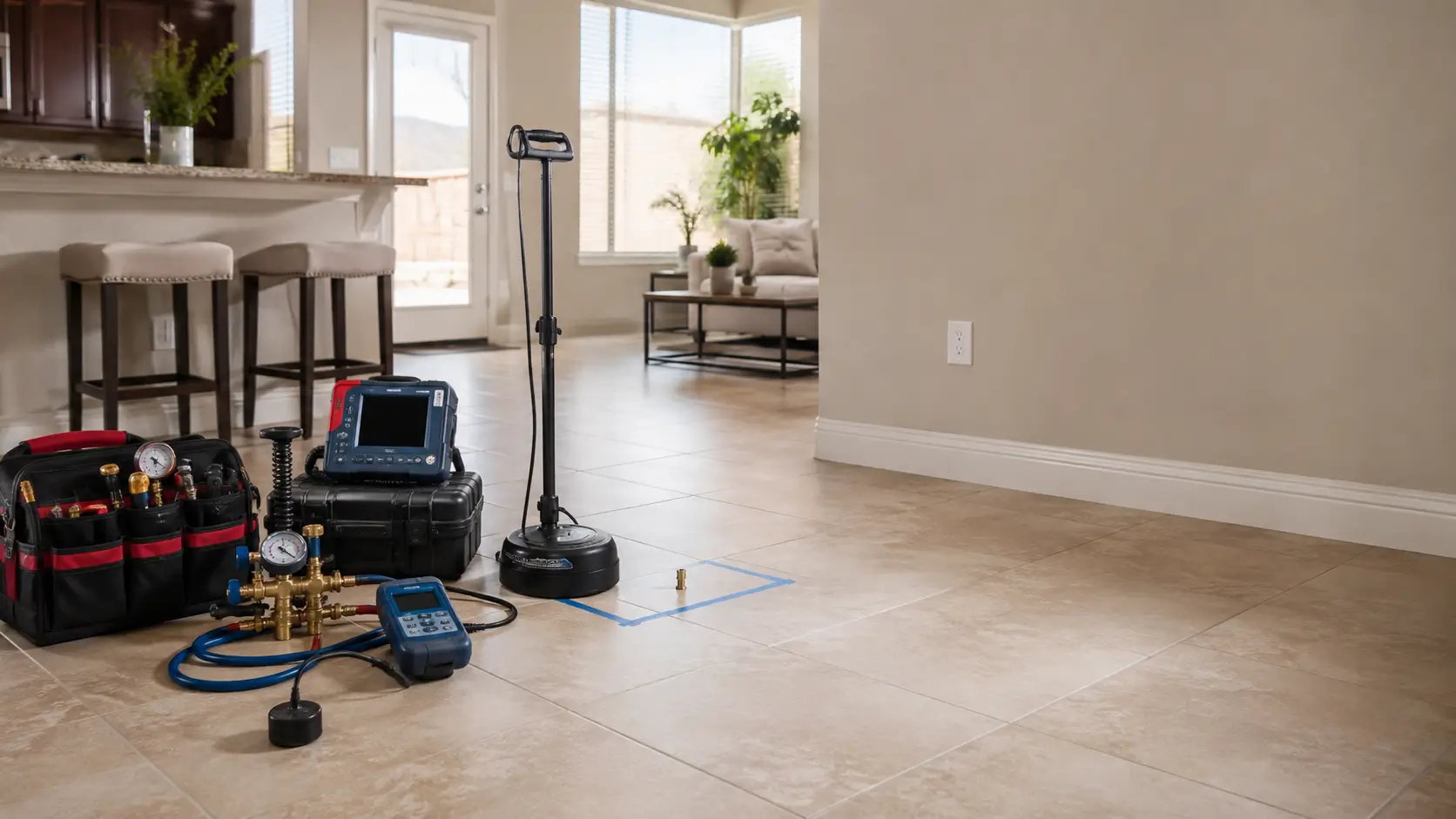
Electronic acoustic sensors amplify the sound of pressurized water escaping from pipes beneath the slab. Trained technicians use this equipment to identify the leak location to within a few inches through the floor surface without cutting or demolition. For original Green Valley homes with aging copper or polybutylene supply lines, acoustic detection pinpoints the failure location before any repair approach is selected.

Pressure Testing

Pressure testing isolates which section of the plumbing system is losing pressure, confirming an active slab leak and identifying which line is affected. For Green Valley homes with multiple aging pipe runs, pressure testing helps narrow the detection area efficiently. We also use pressure testing after all repairs to confirm the line holds pressure before closing up the work area.

Thermal Imaging

Hot water line slab leaks release heat that travels upward through the slab and creates temperature differences visible on floor surfaces. Thermal imaging cameras detect these warm spots, helping narrow the search area before acoustic sensors confirm the precise location.

Why Slab Leaks Are Common in Green Valley, Henderson

Green Valley's combination of aging pipe materials, hard water, and desert soil conditions creates elevated slab leak risk, particularly in the original communities that were developed from the late 1970s through the mid-1990s.

  • Aging Pipes in Green Valley's Original Neighborhoods

    Green Valley's original neighborhoods, developed from the late 1970s through the mid-1990s, carry the highest slab leak risk in Henderson. Homes in this era were built primarily with copper supply lines that have now been exposed to Las Vegas Valley hard water for 30 to 45 years. Over that period, dissolved minerals have continuously thinned pipe walls from the inside out, creating conditions where under-slab failures are increasingly common. Some homes from this era also contain polybutylene pipe, a gray plastic material widely installed from the late 1970s through the mid-1990s that is prone to sudden failure without warning. Green Valley Ranch, developed from the mid-1990s through the mid-2000s, carries a lower but still present slab leak risk as those homes reach 20 to 30 years of age.

  • Caliche and Expansive Clay Soil Movement

    Green Valley sits on caliche and expansive clay soils that shift with seasonal temperature changes and rainfall. This soil movement places ongoing mechanical stress on pipes running beneath concrete slab foundations, creating friction points where pipe contacts rebar or aggregate and stressing joints and connections under the slab. Original Green Valley neighborhoods, where pipes are already thinned by hard water corrosion, carry the highest combined risk from this factor.

  • Hard Water Mineral Corrosion

    Green Valley receives the same Las Vegas Valley municipal water supply as the rest of Henderson, drawn from Lake Mead and measuring 17 to 24 grains per gallon of dissolved minerals (approximately 280 parts per million). This places Green Valley among the hardest municipal water environments in the United States. Sustained hard water exposure thins copper pipe walls from the inside out continuously over decades, accelerating the rate of pinhole leaks and under-slab failures throughout original Green Valley homes.

  • Closed-Loop System Pressure Cycling

    Most Green Valley homes operate on a closed-loop plumbing system due to backflow preventers at the street meter. Water heating causes thermal expansion that creates repeated pressure spikes in the closed system. Over years, these pressure cycles accelerate pipe fatigue in pipes already thinned by hard water corrosion and stressed by caliche soil movement. The combination of corrosion, soil stress, and pressure cycling is the primary driver of slab leaks in original Green Valley homes.

Slab Leak Repair Options in Green Valley

Red Carpet Plumbing presents all applicable repair options before any work begins. The right option depends on the leak location, the age and condition of the affected pipe, whether additional failure points are likely on the same line, and what sits above the repair area.

Spot repair through concrete

Spot repair involves cutting the concrete slab directly above the leak location, repairing or replacing the damaged pipe section, and patching the concrete. This is a focused approach appropriate for an isolated leak in a pipe that is otherwise in good condition. For original Green Valley homes where the surrounding pipe has been thinned by decades of hard water corrosion, a single spot repair may be followed by another leak on the same aging line. See our water pipe repair and replacement services.

Pipe rerouting

Pipe rerouting bypasses the damaged section entirely by running a new supply line through walls, ceilings, or accessible above-slab pathways, removing the aging pipe from beneath the foundation. For original Green Valley homes where copper or polybutylene supply lines have been thinned by 30 to 45 years of hard water exposure, rerouting is often the more durable long-term solution because it eliminates the source of future slab leaks on that line. See our Green Valley re-piping services for homes where the full supply system may be approaching similar age and condition.

Epoxy pipe lining

Epoxy pipe lining applies a specialized coating to the interior of the existing pipe, sealing cracks and restoring pipe integrity from the inside without excavation. This method is less invasive than concrete cutting and works best for pipes with localized damage where the overall pipe structure is still intact. It is not appropriate for pipes with extensive corrosion or significantly narrowed interior diameter.
How Red Carpet Plumbing Handles Slab Leaks in Green Valley

When you call Red Carpet Plumbing for a slab leak inspection in Green Valley, our licensed plumbers follow a consistent process to locate the leak precisely and present your repair options before any concrete is cut.

  1. Detect and locate the slab leak precisely

    We use acoustic sensors, pressure testing, and thermal imaging to locate the slab leak to within a few inches. Accurate location is essential because the repair method depends on the leak's position relative to the foundation, the pipe routing, and what sits above. For original Green Valley homes with aging copper or polybutylene supply lines, we also assess the condition of the surrounding pipe as part of the detection process.

  2. Assess the pipe condition and repair options

    We assess the age and material of the affected pipe, the severity of the leak, whether additional failure points are likely on the same line, and what sits above the leak location. This assessment determines whether spot repair, pipe rerouting, or epoxy lining is the most appropriate solution for your specific Green Valley home.

  3. Present repair options clearly before starting work

    We explain each applicable repair option, including what it involves, how long it takes, what access is required, and what the job will cost, before any work begins. We do not start a slab leak repair without your understanding and approval of the approach.

  4. Complete the repair and verify the line holds pressure

    After completing the repair, we pressure test the affected line to confirm it holds pressure and the leak is fully resolved. We do not close up the work area until testing confirms the repair is complete.

Suspected Slab Leak in Green Valley?

Slab leaks cause ongoing water loss beneath your foundation and can lead to structural damage if left undetected. Red Carpet Plumbing provides non-invasive slab leak detection throughout Green Valley and Henderson. Call or request service online.

Green Valley and Nearby Henderson Communities We Serve

Red Carpet Plumbing provides slab leak detection and repair throughout Green Valley, part of the incorporated City of Henderson. We serve both the original Green Valley neighborhoods and Green Valley Ranch, along with nearby Henderson communities. For full Henderson plumbing service details, see our Henderson plumbing services page.

For Henderson-wide slab leak detection and repair, see our Henderson slab leak detection page.

Slab Leak FAQs for Green Valley Homeowners

What are the signs of a slab leak in a Green Valley home?

The most common signs of a slab leak in a Green Valley home are warm or hot spots on floors, the sound of running water when all fixtures are off, an unexplained increase in your water bill, damp or wet flooring without an obvious source, cracks appearing in walls or flooring, low water pressure throughout the home, and mold or mildew odor at floor level. These signs appear because the leak is beneath the slab and cannot be seen directly.

Why are slab leaks common in Green Valley, Henderson?

Green Valley's slab leak risk is driven by aging copper and polybutylene pipes in the original neighborhoods, which have been exposed to Las Vegas Valley hard water for 30 to 45 years. Hard water mineral corrosion thins pipe walls continuously over that period. Caliche and expansive clay soil movement beneath Green Valley's slab foundations adds mechanical stress to those pipes. Closed-loop system pressure cycling accelerates pipe fatigue in pipes already compromised by corrosion. Original Green Valley homes represent the highest concentration of slab leak risk in Henderson.

Are slab leaks more common in original Green Valley than in newer Henderson neighborhoods?

Yes. Green Valley's original neighborhoods, built from the late 1970s through the mid-1990s, have copper supply lines with 30 to 45 years of hard water mineral exposure, and some homes contain polybutylene pipe that is prone to sudden failure without warning. These conditions make original Green Valley homes significantly more susceptible to slab leaks than newer Henderson construction. Green Valley Ranch homes, built from the mid-1990s through the mid-2000s, carry a lower but still present risk as they reach 20 to 30 years of age.

How is a slab leak detected in Green Valley without breaking up the floor?

Professional slab leak detection uses acoustic sensors that amplify the sound of pressurized water escaping beneath the slab, pressure testing to confirm and isolate water loss to a specific line, and thermal imaging to identify temperature differences caused by hot water leaks. These non-invasive methods locate the slab leak precisely before any concrete cutting begins.

Should I choose pipe rerouting or spot repair for a slab leak in Green Valley?

For an isolated leak in a pipe that is otherwise in good condition, spot repair can be appropriate. For original Green Valley homes where copper or polybutylene lines have been thinned by 30 to 45 years of hard water corrosion, pipe rerouting is often the more durable long-term solution because it removes the aging pipe from beneath the slab entirely and eliminates the source of future slab leaks on that line. Red Carpet Plumbing assesses pipe condition and presents both options before any repair begins.

How long does slab leak repair take in Green Valley?

Detection typically takes a few hours. Spot repair through concrete usually takes one to two days including concrete patching. Pipe rerouting typically takes one to three days depending on the plumbing layout and the length of line being bypassed. Epoxy lining timelines vary based on pipe length and configuration. Red Carpet Plumbing will provide a timeline estimate before work begins.

Suspected Slab Leak
in Green Valley, Henderson?

Do not wait on a suspected slab leak. Call Red Carpet Plumbing at (702) 567-9172 or request service online. We provide non-invasive slab leak detection and repair throughout Green Valley and Henderson.

Call (702) 567-9172