Skip to content
Red Carpet Plumbing logo

Slab Leak Detection and Repair in Enterprise, NV

Red Carpet Plumbing provides non-invasive slab leak detection and repair throughout Enterprise, Nevada and the Southwest Las Vegas area. Enterprise homes in Rhodes Ranch, Mountain's Edge, and surrounding communities built in the late 1990s and early 2000s are now 20 to 25 years old, and the copper supply lines beneath their slab foundations have been continuously exposed to Las Vegas hard water since original construction. We use acoustic sensors, pressure testing, and thermal imaging to locate slab leaks precisely before any concrete cutting begins, and we explain all repair options before starting work. NV Contractor License #0048585A.

  • NV Licensed, #0048585A
  • Non-Invasive Slab Leak Detection
  • All Repair Options Explained
  • Transparent Pricing, No Hidden Fees

Licensed plumbers. Non-invasive detection. Transparent pricing.

Get Slab Leak Help

Tell us what is going on and we will follow up promptly.

Warning Signs of a Slab Leak in Enterprise

The following signs may indicate a slab leak in your Enterprise home. Slab leaks occur beneath the concrete foundation and cannot be seen directly, which is why non-invasive detection methods are essential for accurate diagnosis. For our full slab leak service overview, see our slab leak detection and repair page.

  • Warm or hot spots on the floor, particularly on tile or concrete
  • The sound of running water when all fixtures and appliances are off
  • An unexplained and persistent increase in your water bill
  • Damp or wet flooring without an obvious visible source
  • Cracks appearing in walls or flooring
  • Low water pressure throughout the home with no other explanation
  • Mold or mildew odor at floor level

Non-Invasive Slab Leak Detection Methods

Red Carpet Plumbing uses professional non-invasive detection methods to locate slab leaks precisely before any repair work begins.

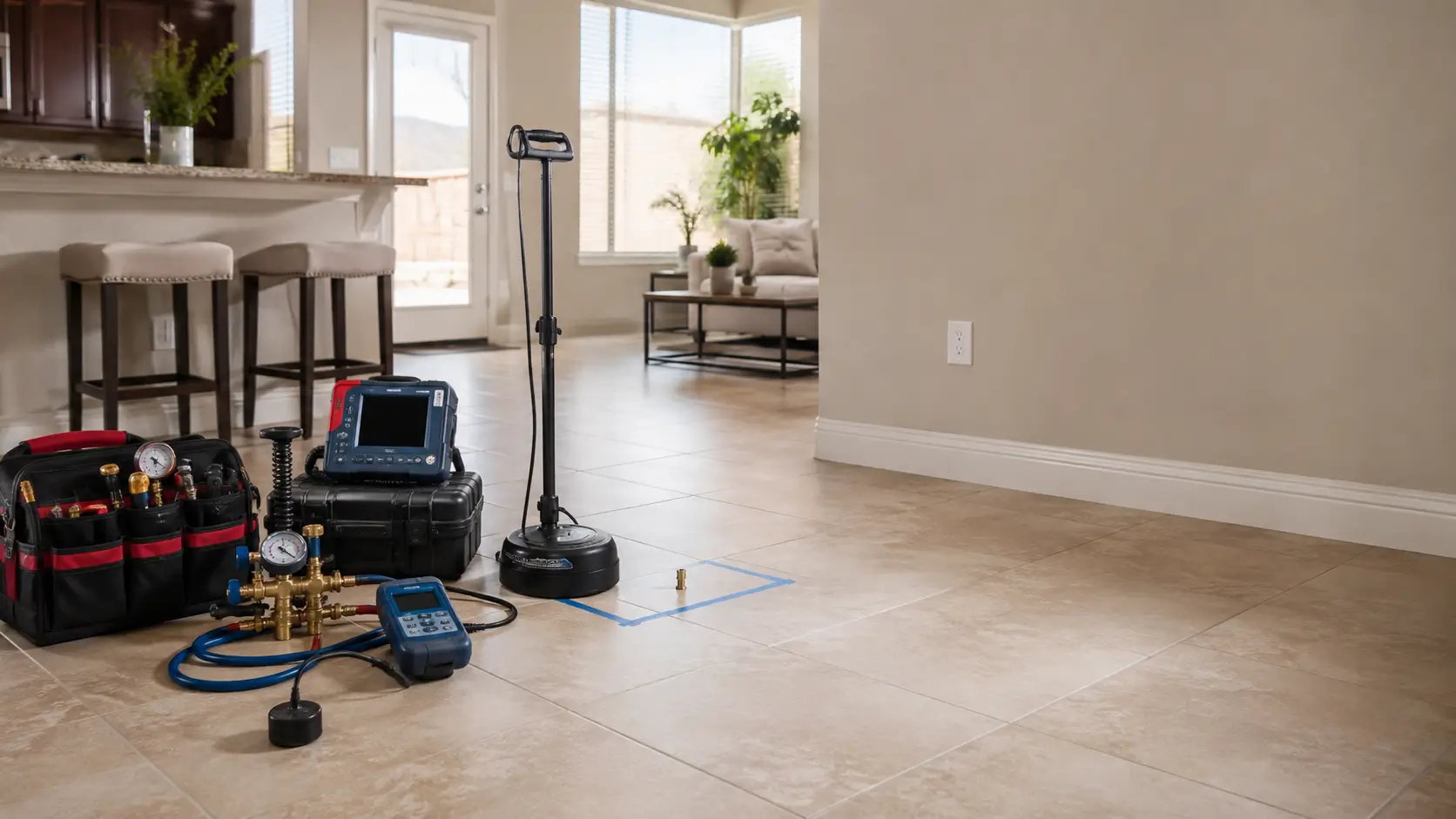
  • Acoustic sensors. Acoustic leak detection equipment amplifies the sound of pressurized water escaping from pipes beneath the slab. Trained technicians use this equipment to identify the leak location to within a few inches through the floor surface without any cutting or demolition.

  • Pressure testing. Pressure testing isolates which section of the plumbing system is losing pressure, confirming an active leak and identifying which supply line is affected. For Enterprise homes with multiple aging pipe runs, pressure testing helps narrow the detection area efficiently.

  • Thermal imaging. Hot water line slab leaks release heat that travels upward through the slab and creates temperature differences visible on floor surfaces. Thermal imaging cameras detect these warm spots, helping narrow the search area before acoustic sensors confirm the precise location.

What Causes Slab Leaks in Enterprise, NV Homes

  • Hard water mineral corrosion in first-service-cycle copper supply lines. Enterprise homes in Rhodes Ranch, Mountain's Edge, and surrounding communities were built primarily in the late 1990s and early 2000s. Their copper supply lines are now 20 to 25 years old and have been continuously exposed to Las Vegas Valley hard water since original construction. Las Vegas municipal water at 17 to 24 grains per gallon, approximately 280 parts per million of dissolved minerals, deposits calcium and magnesium scale inside copper pipe walls over time. This process thins the pipe walls from the inside out. As pipe walls thin, the pressure of the water supply creates stress fractures and pinhole leaks at the weakest points, including where pipes pass through or beneath the slab. Enterprise homes are now entering the age range where this corrosion accumulation produces the first under-slab failures.

  • Caliche and expansive clay soil movement beneath slab foundations. Enterprise is built predominantly on concrete slab foundations, and the caliche and expansive clay soils beneath those slabs shift with seasonal temperature changes and infrequent rainfall throughout Clark County. This soil movement creates ongoing mechanical stress on copper supply lines embedded in and running beneath the slab. Friction points where pipe contacts concrete rebar or aggregate wear through pipe walls over time. Soil settlement and expansion also stress pipe joints and connections beneath the slab. First-service-cycle copper pipes that have been subject to this movement for 20 to 25 years are at elevated risk of under-slab failure.

  • Closed-loop pressure stress and thermal expansion. Most Enterprise homes operate on a closed-loop plumbing system due to backflow preventers at the street meter. Thermal expansion from water heating creates repeated pressure spikes in the closed system. Over 20 to 25 years, these pressure cycles accelerate pipe fatigue, particularly in supply lines running beneath or embedded in the slab. Homes without properly installed thermal expansion tanks are subject to more frequent and more severe pressure spikes.

  • Age-related pipe joint and connection stress. In Enterprise homes now 20 to 25 years old, the original mechanical joints, elbow connections, and transition fittings in the under-slab supply line system have been stressed by two decades of pressure cycling, thermal expansion, and soil movement. These connections are often the first point of failure in aging under-slab systems, producing leaks that present with the same slab-leak warning signs as pipe wall failures.

Slab Leak Repair Options for Enterprise Homes

Red Carpet Plumbing explains all three slab leak repair options before any work begins. The right choice depends on the leak location, pipe age and condition, and the scope of work involved.

Spot repair through concrete

Spot repair involves cutting the concrete slab directly above the leak location, repairing or replacing the damaged pipe section, and patching the concrete. This is the most targeted approach and is appropriate for an isolated leak in a pipe that is otherwise in good condition. For Enterprise homes with 20 to 25 year old copper supply lines, spot repair can be appropriate when a leak is genuinely isolated and the surrounding pipe wall condition is assessed and confirmed to be acceptable. We evaluate the pipe condition before recommending spot repair to ensure a second failure on the same aging line is not likely. See our water pipe repair and replacement page for information on targeted pipe repairs.

Pipe rerouting

Pipe rerouting abandons the damaged pipe beneath the slab entirely and installs a new supply line through walls, ceilings, or above-slab pathways to bypass the foundation. Rerouting eliminates the source of future slab leaks on the affected line and avoids ongoing foundation disruption. For Enterprise homes where the assessment reveals that the surrounding pipe condition warrants concern, or where a second leak on the same line is likely, rerouting is typically the more durable long-term solution. See our re-piping services page for information on full and partial pipe replacement options.

Epoxy pipe lining

For some slab leak situations, epoxy pipe lining is a viable option. A specialized epoxy coating is applied to the interior of the existing pipe, sealing cracks and restoring pipe integrity from the inside without concrete cutting. This method works best for pipes with localized damage where the overall pipe structure remains intact. We assess pipe condition and the nature of the damage before recommending epoxy lining as the repair approach.

Our Slab Leak Process in Enterprise

  1. Detect and locate the slab leak precisely

    We use acoustic sensors, pressure testing, and thermal imaging to locate the slab leak to within a few inches. Precise detection is essential because the correct repair method and scope of work depend entirely on knowing the exact location and the condition of the affected pipe.

  2. Assess pipe condition and repair options

    We assess the age and condition of the affected pipe, the scope of the leak, and the surrounding pipe condition to determine whether spot repair, pipe rerouting, or epoxy lining is the most appropriate approach. For Enterprise homes with first-service-cycle copper, we explain the implications of each option before any work begins.

  3. Present repair options and obtain approval

    We explain what we found, what the repair or rerouting involves, the scope of work, and the cost before starting. We do not begin work without your approval.

  4. Complete the repair and verify

    We complete the approved repair, restore concrete where cutting was required, and pressure-test the affected section to confirm the leak is resolved and the system holds pressure before we leave.

Why Enterprise Homeowners Choose Red Carpet Plumbing for Slab Leak Service

  • Local Las Vegas Valley plumbing company familiar with Enterprise's first-service-cycle housing stock, Rhodes Ranch and Mountain's Edge copper pipe conditions, and Clark County slab foundation conditions
  • Non-invasive slab leak detection that locates the leak precisely before any concrete cutting begins
  • All three repair options explained before work starts so you can make an informed decision
  • Licensed plumbers, NV License #0048585A
  • Transparent pricing with no hidden fees
  • Over 40 years serving the Las Vegas Valley
  • 4.8-star rating across 76 Google reviews

Red Carpet Plumbing provides full Enterprise plumbing services including drain cleaning, water heater repair, leak detection, and emergency plumbing. We also serve communities near Enterprise including Las Vegas plumbing services and Henderson plumbing services.

Enterprise Slab Leak Coverage Areas

Red Carpet Plumbing provides slab leak detection and repair throughout Enterprise and the Southwest Las Vegas area.

  • Rhodes Ranch
  • Mountain's Edge
  • Southwest Las Vegas
  • Enterprise 215 Corridor
  • Southern Highlands Area
  • Silverado Ranch Area
  • Inspirada Adjacent
  • Enterprise Commercial Parks

Slab Leak FAQs for Enterprise Homeowners

What are the signs of a slab leak in an Enterprise, NV home?

The most common signs of a slab leak in an Enterprise home are warm or hot spots on floors, the sound of running water when all fixtures are off, an unexplained increase in your water bill, damp or wet flooring without an obvious source, cracks appearing in walls or flooring, low water pressure throughout the home, and mold or mildew odor at floor level. These signs appear because the leak is beneath the slab and cannot be seen directly. If you notice one or more of these signs, contact a licensed plumber for a non-invasive slab leak inspection.

What causes slab leaks in Enterprise homes?

The primary causes in Enterprise are hard water mineral corrosion that has been thinning copper supply line walls in homes now 20 to 25 years old since original construction, caliche and expansive clay soil movement that stresses pipes beneath slab foundations, repeated pressure spikes from closed-loop plumbing systems, and age-related stress on pipe joints and under-slab connections. Enterprise homes in Rhodes Ranch and Mountain's Edge are entering the age range where these compounding factors produce the first under-slab failures.

How is a slab leak detected without breaking up the floor?

Professional slab leak detection uses acoustic sensors that amplify the sound of pressurized water escaping beneath the slab, pressure testing to confirm and isolate water loss to a specific supply line, and thermal imaging to identify temperature differences caused by hot water leaks. These non-invasive methods locate the leak precisely before any concrete cutting begins.

What are my options for slab leak repair in Enterprise?

The three main options are spot repair through concrete, which involves cutting the slab at the leak location and repairing the damaged pipe section; pipe rerouting, which bypasses the damaged pipe entirely by running a new line through walls or above-slab pathways; and epoxy pipe lining, which seals cracks from the inside without excavation. The right option depends on the leak location, pipe age, pipe condition, and what is above the repair area. Red Carpet Plumbing explains all three options before any work begins.

Should I choose pipe rerouting or spot repair for a slab leak in my Enterprise home?

For an isolated leak in a pipe that is otherwise in good condition, spot repair can be appropriate. For Enterprise homes where the surrounding copper pipe has been assessed and shows signs of thinning from 20 to 25 years of hard water exposure, or where the first slab leak suggests other failure points may exist on the same aging line, pipe rerouting is often the more durable long-term solution because it removes the aging pipe from beneath the slab entirely. We assess the pipe condition and explain both options before any work begins.

How long does slab leak repair take in Enterprise?

Detection typically takes a few hours. Spot repair through concrete usually takes one to two days including concrete patching. Pipe rerouting typically takes one to three days depending on the complexity of the plumbing layout. Epoxy lining timelines vary based on pipe length and configuration. Red Carpet Plumbing will give you a timeline estimate before work begins.

Suspect a Slab Leak
in Enterprise? Call Red Carpet Plumbing.

Red Carpet Plumbing provides non-invasive slab leak detection and repair throughout Enterprise, NV, including Rhodes Ranch, Mountain's Edge, and the Southwest Las Vegas area. Call (702) 567-9172 or request service online.

Call (702) 567-9172